
Institute for Applied Physics
Research at IAP
Modern Optics
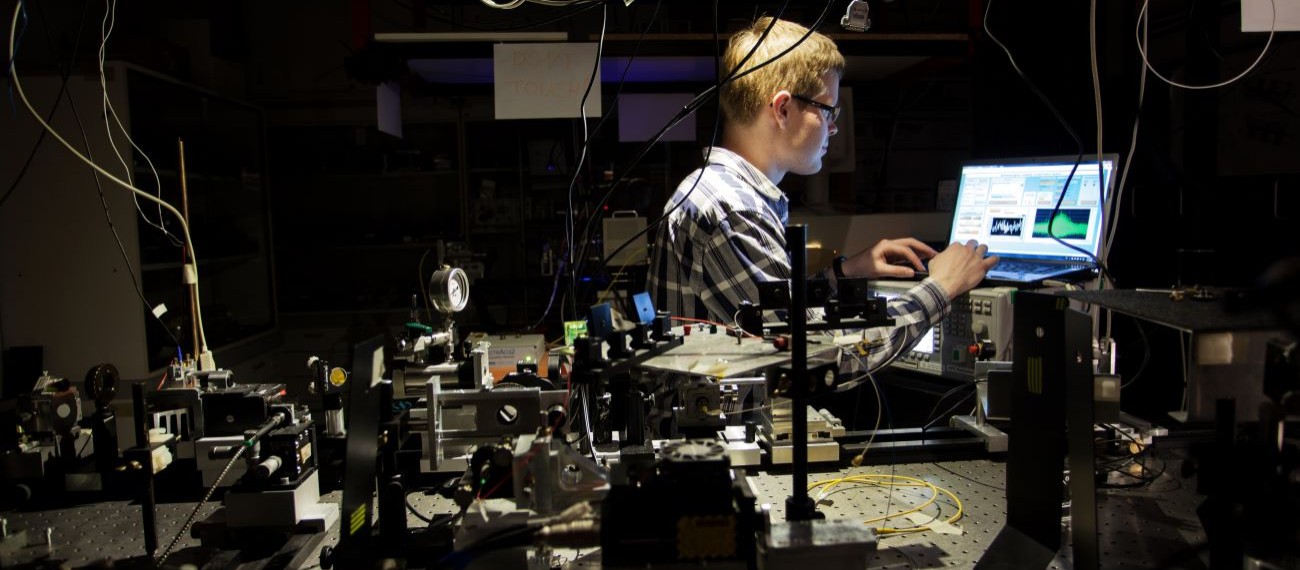
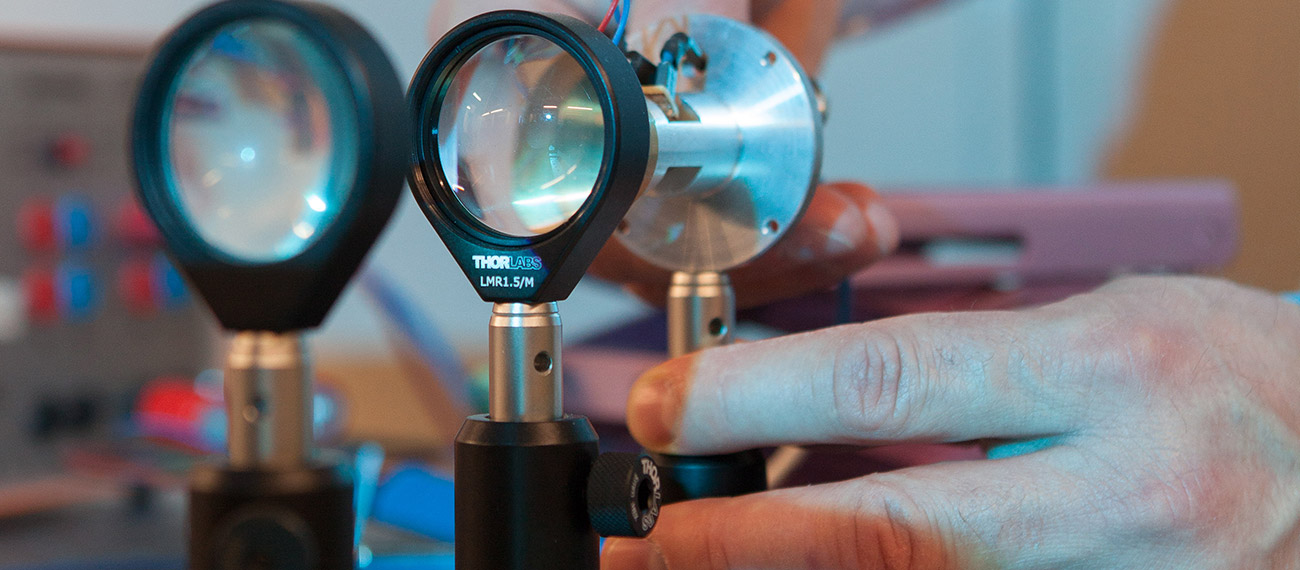
The research focus of the Institute for Applied Physics is on modern optics. In addition to fundamental research, the IAP pursues research activities in application-related fields such as optical data storage, data processing and quantum encryption as well as laser development and laser-based measurement technology. There is also a close connection between the IAP and GSI (Helmholtzzentrum für Schwerionenforschung ) through joint research activities on laser spectroscopy and laser cooling of highly charged ions in storage rings and ion traps.
Research groups
The main topics of the experimental and theoretical research groups at the IAP include quantum optics, quantum information, theoretical quantum technology, cold quantum gases, manipulation of individual quantum systems, laser spectroscopy and laser cooling of stored atoms and ions, nonlinear optic and laser physics as well as experimental solid-state quantum optics.
-
![Teaser AG Bagnoud]()
![Teaser AG Bagnoud]()
PHELIX laser facility (Prof. Vincent Bagnoud)
Ultrahigh-intensity laser physics and development, relativistic laser-plasma interactions
-
![Teaser AG Birkl]()
![Teaser AG Birkl]()
Atoms – Photons – Quanta (Prof. Gerhard Birkl)
Experimental and theoretical research in the fields of Quantum Optics, Quantum Information, Quantum Technology, and Atomic Physics.
-
![]()
![]()
Theoretical Quantum Technology (Prof. Claudiu Genes)
In the terahertz regime, engineered metasurface modes strongly couple to vibrational excitations of glucose molecules, giving rise to hybridized, delocalized states of light and matter—an example of cavity quantum electrodynamics explored in our Theoretical Quantum Technologies group.
-
![]()
![]()
Theoretical Quantum Optics (Prof. Enno Giese)
Quantum optical methods are suitable for testing fundamental physics and are building blocks for the application of quantum technologies in sensor technology and metrology. The research topics range from quantum gases to atomic optics, from non-linear quantum optical effects to atomic interferometry and from quantum metrology to inertial sensors.
-
![]()
![]()
Experimental Solid State Quantum Optics (Prof. Markus Gräfe)
Our research focuses on the exploitation of nonclassical states of light for both fundamental phenomena in quantum physics and application orientated quantum technologies. This ranges from generation of entangled photon pairs or other genuine quantum states of light towards their application in terms of quantum imaging and sensing. Moreover, laser-written waveguide lattices will serve as testbed for fundamental physics as well for photonic quantum walks.
-
![]()
![]()
Nonlinear Optics and Quantum Optics (Prof. Thomas Halfmann)
The research projects on Nonlinear Optics & Quantum Optics deal with coherent light-matter interactions to control optical properties and processes in quantum systems. In particular we aim at novel protocols to implement optical memories as an important prerequisite for optical quantum technologies, new control approaches to enhance ultra-fast nonlinear frequency conversion processes, and performant techniques of nonlinear spectroscopy to detect or image samples of molecular species.
-
![]()
![]()
Theoretical Quantum Dynamics (Prof. Reinhold Walser)
Quantum physics rules the interaction of photons with matter. This raises fundamental questions and leads to metrological applications. We analyze theoretically experiments from matter-wave physics with quantum gases in micro-gravity to laser development.
-
![Teaser AG Walther]()
![Teaser AG Walther]()
Laser and Quantum Optics (Prof. Thomas Walther)
We conduct experiments in the field of laser physics and quantum optics using the laser with its almost endless possibilites.




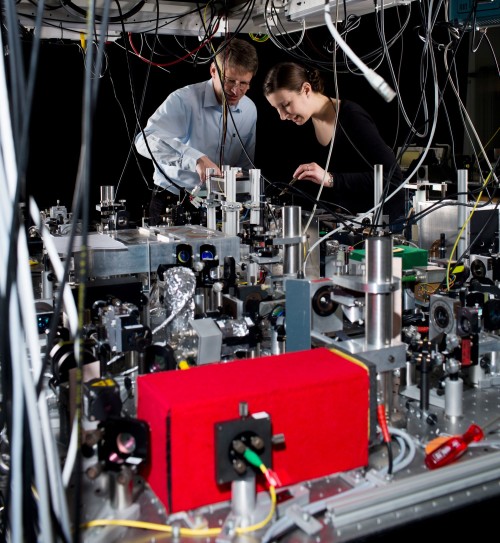
Research at the Department of Physics
The Institute for Applied Physics is embedded in the Department of Physics with the main research focus on Modern Optics, Condensed Matter Physics and Nuclear Physics. The research activities are characterized by collaborative research projects and interdisciplinary networking within and outside the TU Darmstadt.
Doctoral thesis program (Promotion)
Procedure and regulations for doctoral thesis at the Department of Physics
Contact
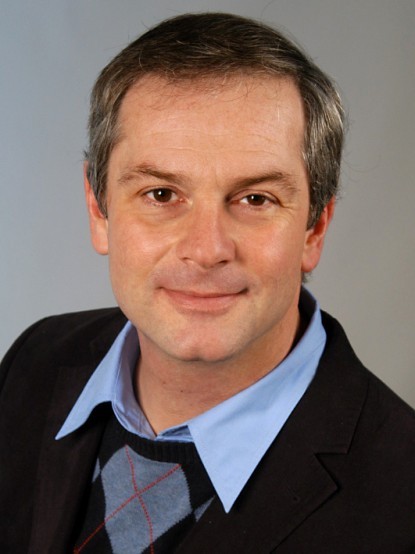
Prof. Dr. Reinhold Walser
gd-iap@physik.tu-...
work +49 6151 16-20320
Work
S2|09 104
Hochschulstr. 4a
64289
Darmstadt
Dagmar Kutschera

sekretariat-iap@physik.tu-...
work +49 6151 16-20401
Work
S2|09 1
Hochschulstr. 4a
64289
Darmstadt
Christine Schütze

sekretariat-iap@physik.tu-...
work +49 6151 16-20321
Work
S2|09 1
Hochschulstraße 4A
64289
Darmstadt